Dynamic pricing for vacation rentals: raise rates without losing bookings

Kyros Kyros | MyStaySite
March 6, 2026
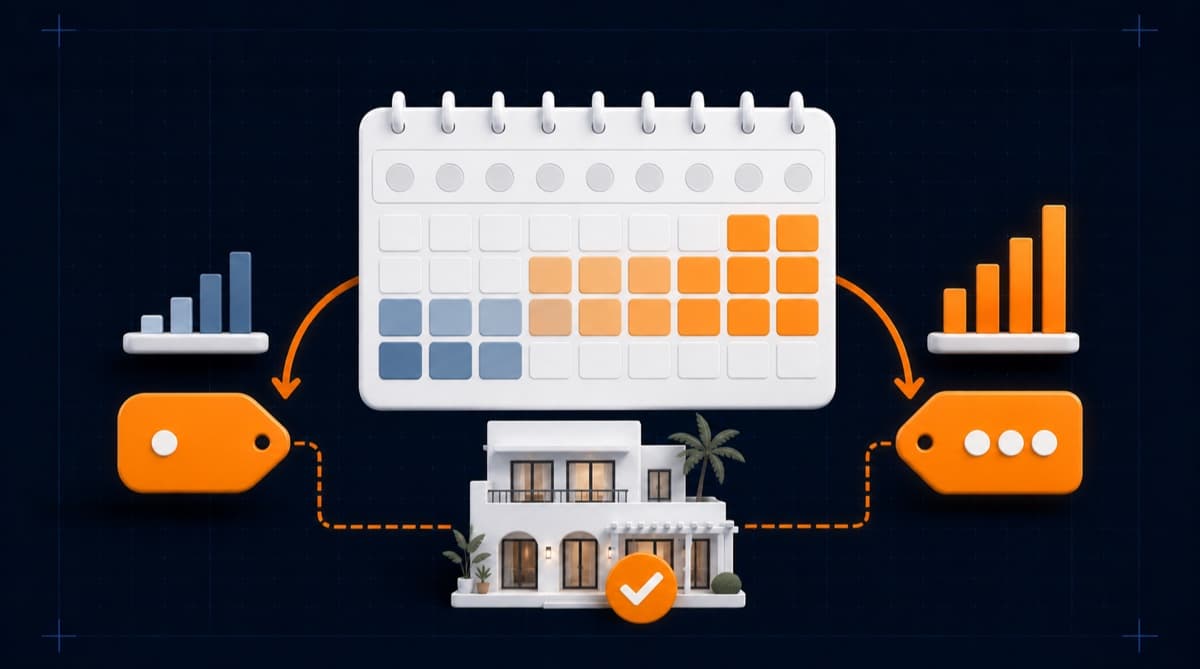
Many owners set one price at the start of the season and leave it untouched for months. That's money left on the table. A vacation rental with a solid dynamic pricing strategy can lift annual revenue by 15-30% with zero extra investment, just by matching prices to demand.
In this guide we'll cover what dynamic pricing actually is, when to raise and when to lower your rates, and which tools are worth it for small properties.
What is dynamic pricing
Dynamic pricing means your rate changes based on:
- Demand (how many people are searching your area)
- Supply (how many properties are available)
- Seasonality (summer vs winter)
- Day of the week (Friday vs Tuesday)
- Lead time (how far ahead of arrival the booking is made)
- Events (festivals, conferences, holidays)
Big hotels run algorithms that reprice every hour. You don't need that level of sophistication, but even a basic pricing strategy can transform your profitability.
The 5 scenarios that need a different price
1. High season (July-August in Greece)
In August, demand is 5x higher than in May. If you're charging the same price, you're leaving money on the table.
Rule of thumb: +40% to +80% above your average rate in peak season.
Specifically:
- July: +30%
- First week of August: +50%
- Mid-August peak (August 10-20): +70% to +100%
2. Low season (November-March)
In the shoulder and low season, the challenge is attracting guests, not maximizing the rate.
Rule of thumb: -20% to -40% below your average rate, with a 1-night minimum stay (instead of 2-3).
The goal: 50% occupancy. A low rate beats an empty room.
3. Last minute (1-3 days out)
Last-minute bookings are an opportunity. The guest is searching frantically and is ready to pay a premium.
Rule of thumb:
- If you have availability in high season: add a +10% last-minute premium.
- If you have availability in low season: drop -15% last-minute to fill the gap.
4. Long stays (7+ nights)
A guest who stays 10 nights costs you the same check-in and check-out but brings 10x the revenue. Worth tempting them.
Rule of thumb: -10% for 7+ nights, -15% for 14+.
5. Special dates
- New Year's Eve on the islands: +50%
- Easter in tourist areas: +40%
- Major festivals (Athens Epidaurus, Release Festival, etc.): +30-50%
- Conferences and trade fairs: +20-40%
To spot events in your area, use a Google Calendar filter or local news sites.
The "smart pricing" method
If you don't want full-blown software, run this routine once a week (15 minutes):
Step 1: Check the competition
On Booking.com or Airbnb, enter dates for the next 30 days and see what 5 comparable properties in your area are charging. Write the prices down.
Step 2: Read the demand
If several properties show "sold out" on specific dates, that's a sign of high demand. Raise your rate.
Step 3: Adjust in real time
If you have 0 bookings for next month while everyone else is filling up: your price is wrong. If everyone else has plenty of availability and you sold out instantly: your price is too low.
Step 4: Test and measure
Every 2 weeks, ask: did revenue go up? Did bookings drop? Find the balance.
Dynamic pricing tools for small properties
With 1-3 rooms, it's not worth paying €100 a month. The best options:
PriceLabs (the most popular)
- Cost: €20-60/month per listing
- Automation: adjusts prices automatically on Airbnb and Booking.com
- Ideal if you have 3+ listings
Beyond Pricing
- Cost: 1% of revenue
- Easy setup
- Good for beginners
Wheelhouse
- Cost: 1-3% of revenue
- Excellent interface
- Custom rules
For a single listing: do it manually. With 3+ listings, a tool pays for itself in 2 months.
7 common mistakes that kill dynamic pricing
1. "Either high or low". No nuance
Many owners simply double their rates at peak and cut them in winter. They ignore weekdays, events, and shoulder season.
2. No weekend pricing
Fridays and Saturdays should be 15-25% more expensive than weekdays. Even in low season.
3. Overdoing minimum stays
A 5-night minimum in August makes sense. In November, it's suicide.
4. No early bird discounts
Bookings made 60+ days out are gold. They lock in revenue. Offer -10% for early bookings.
5. Ignoring the competition
If you're at €120 and everything around you is at €90, you're losing bookings without realizing it.
6. Not raising rates once you're 70% booked
When 70% of the month has filled, raise prices on the remaining dates by 15-20%. That's the moment for scarcity pricing.
7. Same price on Booking.com and your own site
The rate on your own website MUST be lower (or come with extras) if you want to win direct bookings. See our guide to direct bookings.
A practical example
Take a room in Chania with a base price of €80/night.
| Period | Day | Rate |
|---|---|---|
| November | Mon-Thu | €55 |
| November | Fri-Sun | €70 |
| May | Mon-Thu | €75 |
| May | Fri-Sun | €90 |
| July | Mon-Thu | €100 |
| July | Fri-Sun | €120 |
| Mid-August peak | All days | €160 |
Same property, same base price. But +55% in annual revenue.
The bottom line
Dynamic pricing takes a bit of observation and 15 minutes a week. You don't need an economics degree. You need to:
- Know your competition
- Watch the demand
- Experiment with your rates
Want a website that lets you change prices in real time and run Instagram-only offers with no rate parity limits? Tell us about your property and we'll show you what's possible.
Already have a site? See how it is doing.
Get a free technical check of your website, without sharing your email. If you do not have a site or would rather talk it through, send me just your property name.
See the work in practice
Explore real property websites I have builtGet the 10-mistakes guide + 1 practical tip every month
The guide 9 out of 10 Greek vacation rentals need, plus one short email a month with practical tips for winning more direct bookings. No spam. Unsubscribe anytime.
- 10 common mistakes + 10 concrete fixes
- 1 short email a month with new case studies
- No spam. Unsubscribe with one click.
Related articles

Instagram for vacation rentals: a strategy that drives direct bookings
How to use Instagram to move your vacation rental beyond Booking.com and take reservations directly. A practical guide, no theory, no fluff.
Email marketing for vacation rentals: bring past guests back
The most underrated channel for direct bookings. How to build an email list, what to send, and how to turn past guests into repeat guests.

Off-season strategy: how to get bookings in Greece year-round
Low season is an opportunity, not a sentence. How to target digital nomads, remote workers, and shoulder-season travelers who love Greece in November.