Does ChatGPT recommend your property? Run the test
Ask the question a guest would ask about your area and see what it answers today and where it reads it. No one can guarantee what it will recommend.
The test: ask ChatGPT the way a guest would
Opens in a new tab with the question ready, and it usually sends itself. MyStaySite is not affiliated with OpenAI.
See or change the question
Type (optional)
For whom (optional)
Or ask the same question on: Google AI Mode (new tab)Perplexity (new tab)
What you type here stays in your browser. It does not reach me and it is not recorded in analytics.
Shall we look at it for your property?
Type your property's name and location. I will tell you what I would build for your property so that it says clearly what you offer, and what it costs.
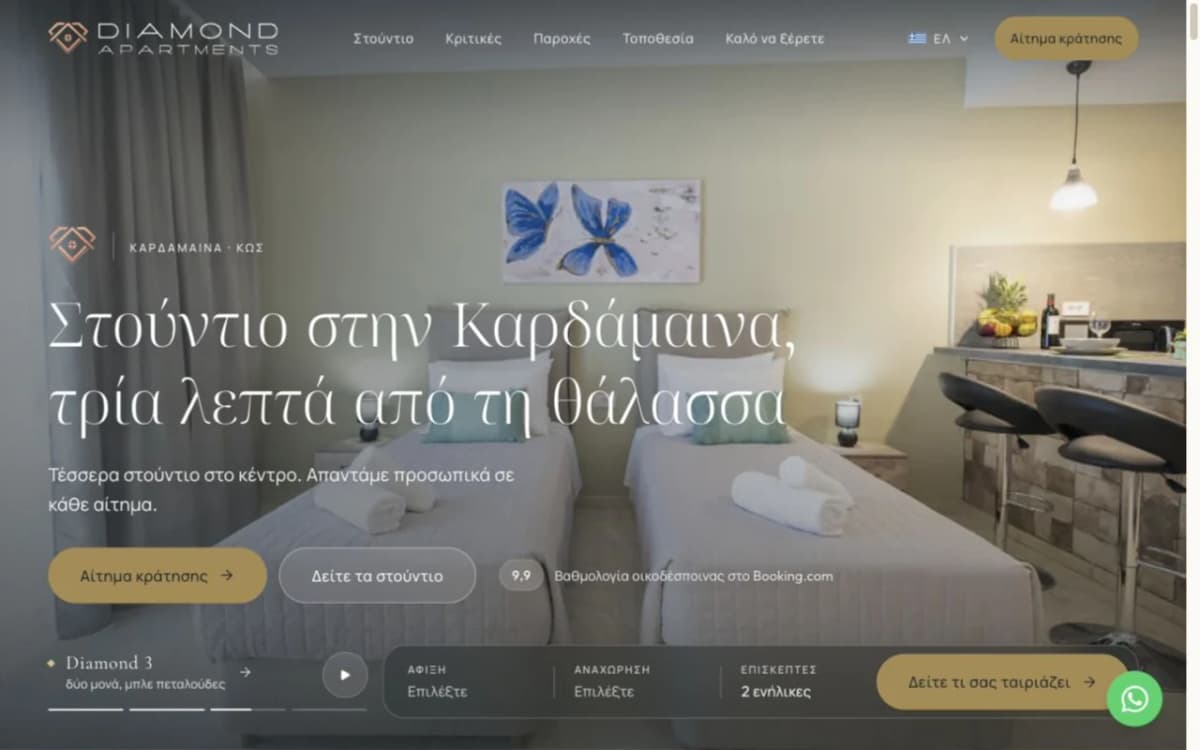
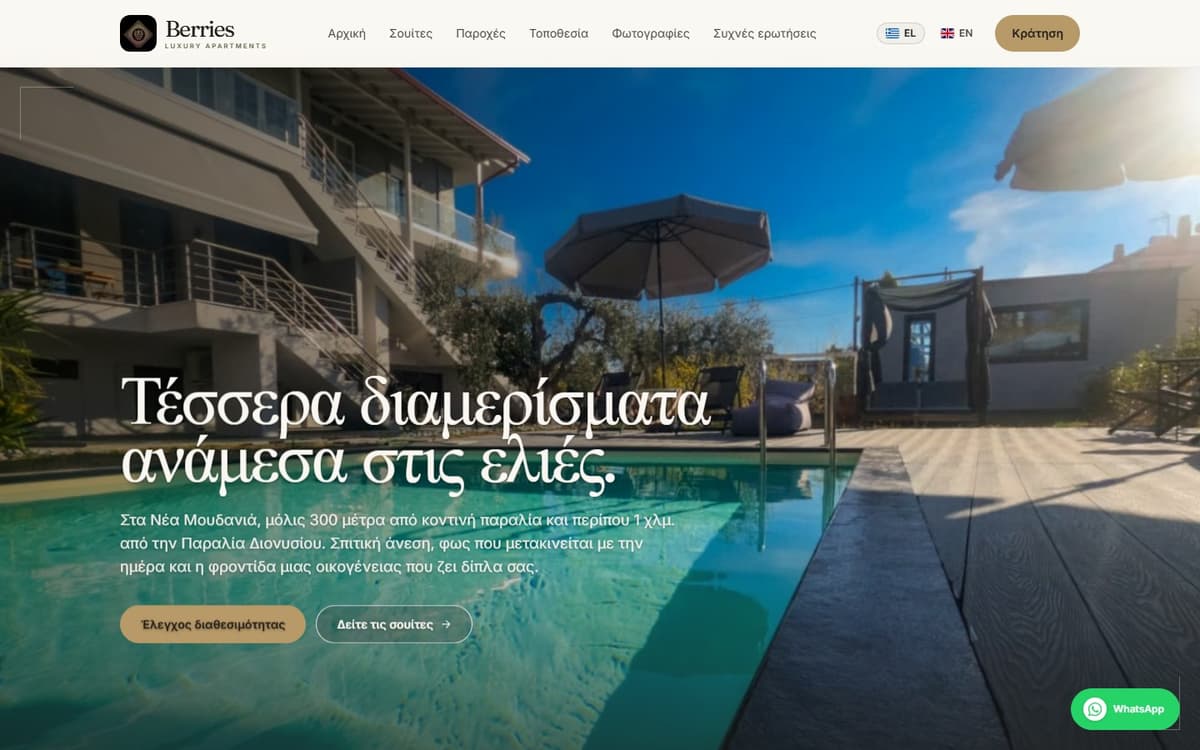
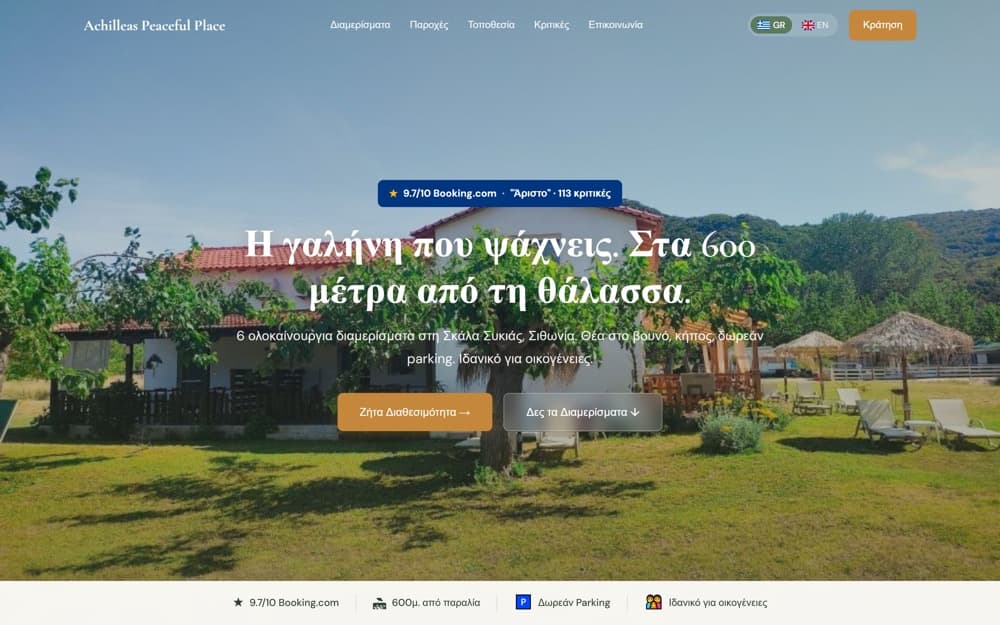
Accommodation websites I have built. See all websites
Website from €900 + VAT for the first year, including domain and hosting. After that, €200 + VAT a year. AI search preparation is part of the website.
The message you will send
Hi Kyros! I read your ChatGPT guide. I have a property and I want ChatGPT to find it and understand it correctly. Property name and location:
I answer myself. The first conversation is free, with no obligation. No one can guarantee what ChatGPT will recommend, including me.
Already have a website? The free check shows what AI tools read on your page, in 20 seconds, no email needed.

Kyros Kyros | MyStaySite
Updated September 23, 2026
How ChatGPT builds its answer
When you ask ChatGPT where to stay, it usually searches the web and puts together an answer from what it finds at that moment. In its help pages on search, OpenAI states that a site's placement in answers is not guaranteed. It also says that it takes the user's approximate location into account and that it uses third party search providers.
So the answer you see from Greece may differ from what a guest in Germany sees, or from what the same guest sees the next day. Do not measure position. Look at two things: whether your details are correct wherever it mentions you, and which sources it took them from.
Sources: OpenAI help pages "Searching the web with ChatGPT" and "Publishers and Developers FAQ", September 2026.
Where it reads about your property
The answer does not come from one place. For a property, the sources are usually of four kinds, and each one needs something different from you.
- Maps and business listings. For questions with a location, OpenAI says it also uses third party providers, for example for nearby businesses, and on a phone it may show a map. Check your name, pin and phone number. If you have a Google Business Profile, keep it up to date with my setup guide. Google's rules exclude holiday homes that are simply rented out, so not every property can have a profile.
- Platforms and reviews. Booking.com, Airbnb, Tripadvisor and your reviews there are public pages an AI tool can read. Keep the details identical to everything else and reply to reviews. You do not need to close any listing.
- Local guides and blogs. Travel guides, local sites and articles about your area are sources too. A mention there is earned, not bought: a partnership with a local business or a story worth writing opens those doors.
- Your own website. The only source you write in full. It should say from the start what you are, where and for whom, with specific details, and it should not block search bots. In the Greek Hospitality Digital Census 2026, almost 4 in 10 small Greek properties had no website of their own (38.1% across 1,839). And of the 3,152 accommodation websites I measured, only 8 in 100 declared in structured data that they are accommodation.
What your page should say
You do not need dozens of articles to start. Build a complete presentation around the questions guests already ask you. Consider a question like:
"Where can we stay in Sithonia with two children, a kitchen and parking?"
"An unforgettable holiday in paradise" answers none of those questions. A beautiful photo does not explain how many people a room sleeps or whether the kitchen is private. For a property that genuinely has these features, a useful description might be:
"An apartment for two adults and two children, with a separate bedroom, an equipped kitchen and one parking space per apartment."
This is an illustrative example, not a description of a real property. Its value is specificity: guests, and any tool reading the page, can tell whether the accommodation fits without asking you every basic question.
| What guests ask | What your page should explain |
|---|---|
| "Will we all fit?" | Capacity, beds and layout for each room type. |
| "Can we cook?" | What the kitchen actually contains, beyond a generic icon. |
| "How close is the beach?" | A checked distance, specifying walking or driving. |
| "Is there parking?" | Private or public parking, availability and any charge. |
| "Does it look like the photos?" | Recent images and genuine reviews with their source. |
| "What will we pay?" | The total price for their dates, or a clear way to request it, including what is covered and any additional charges. |
| "What if our plans change?" | The cancellation and payment terms for the specific booking. |
| "How do we proceed?" | A clear availability enquiry or online booking option, depending on the system you use. |
Include limitations too. Stairs without a lift, a busy nearby road or seasonal opening dates are useful information. They help attract guests whose expectations match the stay.
Accommodation research supports this approach. In Expedia Group's 2025 Traveler Value Index, in its findings for hotels in the US, price and positive reviews were leading hotel selection priorities, alongside the importance of refunds and flexible changes. In Baymard Institute's accommodation website testing (2022), incomplete descriptions and unclear charges made choosing a stay harder.
This is how I organise content on every site I build: around these actual details. You know your property and the questions guests ask. I turn that knowledge into clear pages, so travellers can understand what you offer and whether the stay suits them.
What you can check yourself this week
- Ask 3 to 5 questions the way a guest would, for different guests and seasons, and note the sources of each answer. Run the test again ↑
- Put your details side by side on maps, platforms and your website: the same name written the same way, the same phone number, the right pin, the same amenities. If one page says parking is free and another says there is none, no tool knows which is true. Wherever they differ, fix that first.
- If you have a website, check that it does not block AI search bots. The free check shows it in about 20 seconds, with no email, along with whether the page declares that it is accommodation.
- Add your website to Bing Webmaster Tools as well, not only to Google. Bing keeps its own index, and Microsoft Copilot relies on it.
- Ask for reviews where your guests already book, and reply to them. See how to get more Google reviews.
- If you do not have a website yet, see what yours could look like with the free plan. It shows how you appear in Google listings today and what a page of your own would look like. It does not measure AI recommendations.
Make it easy to move towards a booking
AI search preparation supports discovery. The page a guest reaches then needs to make the next step clear, including on their phone.
- Choose a room. Find the photos, capacity, amenities and essential terms together for that specific option.
- Provide dates and guest numbers. Use a clearly visible button and a short form or message, without searching for a way to contact you.
- Know how the booking is completed. Either receive availability, a total price and confirmation instructions from you, or complete the booking online through a connected booking system.
The journey I design is: understand the stay → choose dates → proceed to confirmation. A WhatsApp message is an enquiry, not a confirmed reservation. If you need live availability, online payment or synchronisation with platforms, we choose a suitable system together and agree its costs separately.
The technical preparation, in plain language
A clear presentation also needs technical preparation: who can read the pages, how they find your rooms and how the information is organised. I handle that setup. Below, I explain what each part does and why it matters.
What I set up behind your website
You do not need to learn to code. The technical preparation supports a simple journey:
Access
Search engines can read the public pages.
Clear information
Rooms, amenities and location are described accurately.
A path to booking
Guests can easily find how to request availability or book through a connected system.
Open any topic for a plain-language explanation.
Which pages crawlers are allowed to readrobots.txt · Allow / Disallow
robots.txt gives instructions to crawlers, the programs that visit pages. Allow permits specified paths; Disallow asks crawlers not to read them. I check the applicable rules so your rooms and public information are not accidentally blocked.
An explicit Allow is not always needed: access may already be permitted. I do not replace the file with a blanket instruction to open everything. robots.txt does not protect private data or bypass passwords.
AI search and training are separateOAI-SearchBot · GPTBot · ChatGPT-User
There is no single setting for every AI service. In ChatGPT, these roles differ:
- OAI-SearchBot
- Handles ChatGPT search and surfacing websites in its search results.
- GPTBot
- Collects content that may be used for model training. Permission is independent of search access.
- ChatGPT-User
- May visit a page following a user action. It does not determine search inclusion.
Checking for other technical blocksnoindex · Server access
noindex is an instruction in a page or server response asking for exclusion from a search index. It does not belong in robots.txt. Google must be able to read the page to apply it. I check public pages for unwanted noindex instructions, errors and blocks imposed by site protection systems.
I do not turn off security across the site to admit a crawler. Guest details, reservations and private files remain protected by actual access controls.
Finding the right pages and informationsitemap.xml · Readable content
sitemap.xml is a directory of website addresses. It helps page discovery, not ranking priority. Essential information also belongs in the pages as text, rather than only within photos.
For example: how many people the apartment sleeps, what its kitchen contains and the distance to the beach. Both the traveller and a search tool need to be able to read those details.
Organised information about your propertyStructured data · Schema
I add appropriate technical fields for facts such as the name, address and property type. They must match what guests see on the page. I do not invent reviews or amenities.
This is not an AI certification. Google’s AI features do not require a special “AI schema”, and structured data alone does not guarantee inclusion.
A short guide to your contentllms.txt · Supplementary, not a prerequisite
llms.txt is a proposed, optional file format with a brief introduction and links to useful information. For accommodation, it could organise room, amenity, location and contact pages for tools that use it.
It does not grant access, replace robots.txt or register your property with ChatGPT. I do not present it as a prerequisite for appearing. Google says it does not use it for Search visibility or rankings. I treat it as supplementary content organisation, not a promise of promotion.
You provide the information. I handle the setup.
The aim is an accessible, understandable website that helps your guests. Technical preparation does not guarantee that an AI service will select or recommend your property.
Explanation based on OpenAI Crawlers, Google Search Central and the llms.txt proposal. Documentation checked on 6 September 2026.
How to tell whether it brings interest
Do not treat a screenshot of one conversation as proof of success. For your business, track:
- Visits from AI services. Those that come from ChatGPT usually carry the tag utm_source=chatgpt.com, as OpenAI states in its guidance for publishers, and they show up in analytics. That is how I see them on my own website too.
- Actual messages and enquiries, not just WhatsApp button clicks.
- Bookings that were confirmed, and guests' answers to "Where did you find us?"
What I handle and what it costs
I start with the property, not a ready made template. We discuss your location, rooms and the guests you want to attract. I write the copy in Greek and English with your actual details, you check it before publication, and I build the structure so that search engines and AI tools can read it. I organise rooms, amenities, location and terms, alongside clear contact options or your chosen booking system.
The website starts from €900 + VAT for the first year, including domain and hosting. After that, €200 + VAT a year for maintenance, which includes their renewal. AI search preparation is part of the website, not a separate charge. You keep Booking.com: the site works alongside it, as the direct way to reach you.
I do not promise a position on ChatGPT or a number of bookings. I promise a website that says clearly what you offer and makes it easy for guests to write to you. Explore real websites I have built and what the service includes.
Frequently asked questions
Can you guarantee that ChatGPT will recommend my property?+
No. No one can, and OpenAI itself states that a site's placement in answers is not guaranteed. I handle the website's structure, content and technical preparation. I do not control which sources or properties an AI service selects.
How do I get ChatGPT to recommend my property?+
No setting guarantees it. You can look after the sources it reads: the same, correct details on maps, platforms and reviews, and a website of your own that says clearly what you are, where and for whom, without blocking search bots. That is the preparation I include in every website I build at MyStaySite.
Do I need my own website for ChatGPT to find me?+
Not necessarily. ChatGPT also reads platforms, maps and guides. There, though, others write the text or the platform limits it. Your own website is the only source where you write the whole picture of your property and show guests how to book directly with you.
I do not have my own website. Where do we start?+
With a conversation about your property, your guests and how you currently take bookings. We look together at the material you have and what is missing. I handle the design, copywriting and technical setup. You check the information and approve the presentation.
Why does the answer I saw differ from what a guest sees?+
The answer can depend on location, language, account, previous conversations and the day. Without signing in, or inside the Instagram and Facebook browsers, it may differ from what a signed in traveller sees. That is why we look at sources and accuracy, not position.
How soon will I see results?+
There is no fixed deadline for appearing in AI answers. Website delivery and discovery are separate things. You have access to visitor statistics and can record the enquiries you receive. I do not promise rankings or a number of bookings.
Do you keep what I type in the test?+
No. The area and the name stay in your browser, for this tab only. When you press a button, the question goes straight to ChatGPT, Google or Perplexity, and the message to WhatsApp, Messenger or your email app, under each service's own terms. If you open the free check, your website address goes to the check tool, just as if you typed it there. My analytics record anonymously only which buttons were pressed, which options you picked from the fixed lists and whether a name and an area were filled in, never what you type.
Send me your property
Type the name and location, with or without a website. The message writes itself and you see it before you send it.
Website from €900 + VAT for the first year, including domain and hosting. After that, €200 + VAT a year. AI search preparation is part of the website.
The message you will send
Hi Kyros! I read your ChatGPT guide. I have a property and I want ChatGPT to find it and understand it correctly. Property name and location:
I answer myself. The first conversation is free, with no obligation. No one can guarantee what ChatGPT will recommend, including me.
Haven't run the test yet? Ask ChatGPT ↑
Accommodation websites I have built
Related articles

Google Business Profile for accommodation: eligibility and setup
Check whether your accommodation business is eligible before setting up a Google Business Profile. Individual holiday rentals are not eligible.
How to get your vacation rental on Google (beginner SEO guide)
A step-by-step SEO guide for vacation rental owners who want to show up when travelers search Google. No jargon, no marketing degree required.
Your First Website for a Small Accommodation: What Do You Need?
A few rooms, studios or apartments and only a Booking.com or Airbnb listing? What your first website needs, who does the work and how to start.