The complete guide to direct bookings in 2026

Kyros Kyros | MyStaySite
April 7, 2026
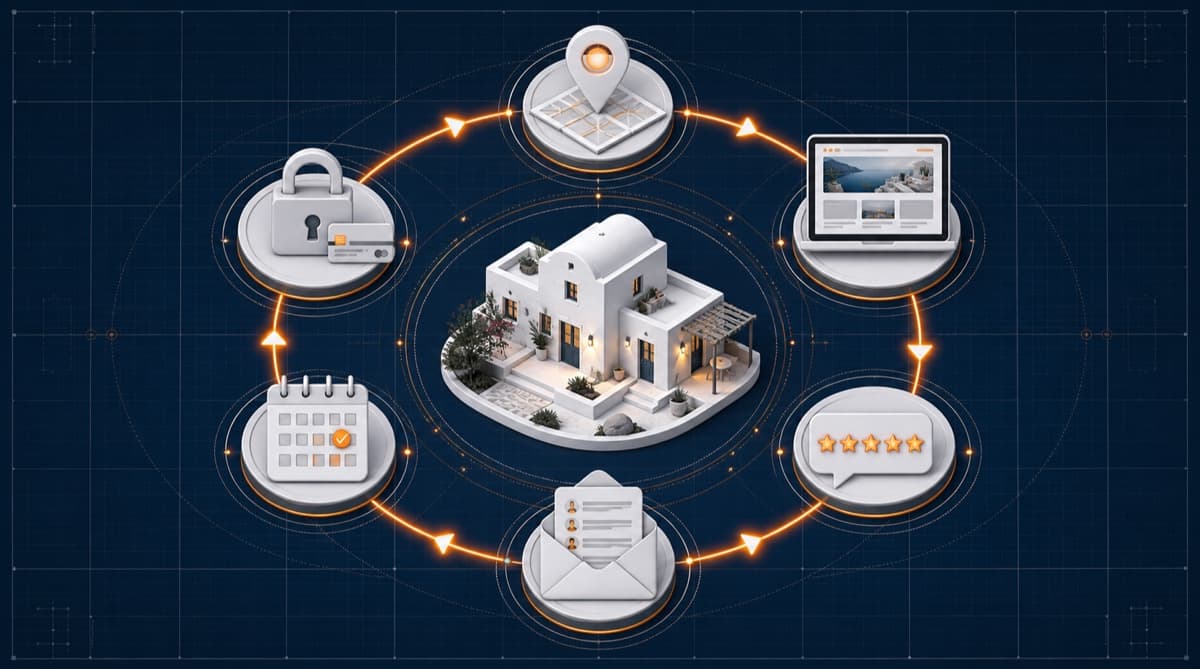
A direct channel gives guests a way to reach your property without relying on one platform. This guide covers the website, search, reviews, guest communication, payments and measurement needed to support it.
The financial examples are illustrative scenarios, not MyStaySite results or promises. A website makes direct enquiries possible; it does not create demand or guarantee reservations.
What direct bookings are
A direct booking is a reservation agreed between you and a guest through your website, phone, WhatsApp or email, without an OTA mediating that reservation. It avoids that OTA commission, but not every business cost.
A direct relationship lets you explain your policies and communicate about the stay. Marketing permission is a separate matter: do not treat a guest email or an OTA export as automatic permission to send promotional messages.
You do not need to leave the platforms or start with an instant booking engine. A clear enquiry form with dates can support direct requests, which you then confirm after checking availability.
From here on, this guide is the how, step by step.
Table of contents
- Why a direct channel is worth evaluating
- The foundation: a website that actually works
- SEO for vacation rentals: how Google finds you
- Google Business Profile: the most powerful free tool
- Reviews: the invisible conversion engine
- Email marketing: the invisible direct-booking channel
- Direct booking engine: the key to conversion
- Payments: the gray area that loses bookings
- AI: the new traffic source
- Social media & UGC: the visual layer
- Partnerships & local presence
- The KPIs you should measure
- The 90-day roadmap
- Illustrative implementation scenario
- The 5 most common mistakes
- When to bring in professional help
Part 1: Why a direct channel is worth evaluating
Illustrative commission scenario
Assume €80,000 annual booking revenue, unchanged prices and an assumed 16.5% commission on OTA revenue. These are example inputs, not industry averages.
| OTA share of revenue | OTA revenue | Assumed commission | Commission avoided versus 70% OTA |
|---|---|---|---|
| 70% | €56,000 | €9,240 | — |
| 50% | €40,000 | €6,600 | €2,640 |
| 30% | €24,000 | €3,960 | €5,280 |
The savings are differences in OTA commission, not net profit. Deduct direct-channel discounts, marketing, payment processing, website and software costs. No VAT treatment is assumed. Booking.com shows each property's commission at the agreement stage. Booking.com registration FAQ
The objective is more choice in how guests reach you, not replacing every platform reservation.
Price parity: an important EU correction
The old blanket claim that Booking.com prevents a cheaper price on your own website is outdated for the EU. Since 14 November 2024, the DMA obligations applying to Booking.com prohibit parity clauses and equivalent retaliation. Providers can offer different, including better, prices and conditions on their own channels. This is not a worldwide statement about every OTA. European Commission
Other channel considerations
- Platform visibility can change, so avoid relying on a single source of enquiries.
- Compare actual acquisition costs rather than inventing an extra “effective commission” percentage.
- Build guest communication around valid permissions and clear preferences.
Part 2: The foundation: a website that actually works
Without a good website, nothing else matters. Your site is where everyone lands, whether from Google, Instagram, TripAdvisor, or AI assistants.
The 8 non-negotiables of a good vacation rental website
- Good mobile performance. Use PageSpeed Insights to identify loading and responsiveness problems; do not equate a lab score with bookings.
- Mobile-first design. Everything designed for a 375px screen first, not a laptop.
- A clear primary goal (CTA). Visitors should know how to book within 3 seconds.
- SSL (HTTPS). Without it, the browser shows a warning and trust evaporates.
- Professional photos. At least 20-30 images, all around 1200px wide, optimized as WebP.
- Season and availability shown. Guests want to know if you're available.
- Reviews front and center. Trust = conversion. At least 6-10 reviews on the homepage.
- Multilingual. Greek + English is the bare minimum. Add German or French if that's your audience.
Your build options
- DIY tools: compare current subscriptions, features and the time you will spend maintaining the site.
- WordPress with a theme: Flexible, but you own hosting, maintenance, and plugins.
- Custom-built (Next.js, Astro): Fast, SEO-friendly, low long-term cost.
- Managed, done-for-you: Someone builds it and maintains it, ideal if you'd rather focus on your guests.
At MyStaySite, you provide the property photos and Kyros handles the website setup and ongoing management within the agreed service. Packages start from €900 + VAT (first-year domain and hosting included if you do not have them), with custom quotes for more complex needs. Scope and timing are confirmed in the proposal.
The right homepage hierarchy for a vacation rental
The order in which visitors see your content makes a huge difference to conversion:
- Hero section (above the fold): property name, location, 1-2 key benefits, primary CTA "Check availability."
- Social proof: show only genuine ratings with their source and current review count; never use example numbers as real proof.
- Property photos (masonry or carousel, 8-12 images).
- Key features with icons (pool, view, wifi, parking).
- About section: 2-3 paragraphs about the property and its owners. A human story converts.
- Amenities in detail: checklist format.
- Reviews carousel with 5-7 reviews.
- Location & attractions (map + "5 minutes from the beach," "15 minutes from town").
- FAQ section: the 6-10 questions you keep answering by email.
- Final CTA: contact form + phone + WhatsApp.
Treat that order as a starting point, not a conversion formula. Test whether visitors can find the information they need.
The photo mistake everyone makes
Clear, accurate photos help visitors understand the property. Use the photos you have and replace missing or misleading views; there is no guaranteed photography payback period. Priorities:
- Golden hour shots of the exterior (1 hour before sunset).
- Wide-angle interior shots with clear context (the whole room in frame).
- Lifestyle shots: not empty rooms but atmosphere, a book on the bed, coffee on the balcony.
- Detail shots: textiles, bathroom, the view.
Photos, price, location, availability and trust all matter. The right balance depends on the guest.
Part 3: SEO for vacation rentals: how Google finds you
SEO isn't a hack. It's speaking the language your guests use when they search.
The 4 search types that matter to you
- Brand searches: "Villa Afroditi Antiparos." Check whether your official site is easy to find; no ranking is guaranteed.
- Geographic searches: "where to stay in Antiparos," "Paros rooms to rent." These are gold, high booking intent.
- Feature searches: "villa with pool Naxos," "family rooms Santorini."
- Long-tail searches: "best sea-view apartments for kids in Corfu."
On-page SEO essentials
- Title tag: 50-60 characters, including name + location + property type.
- Meta description: 140-155 characters with a call to action.
- H1: One per page. A clear title.
- URL:
/diamerismata-antiparosinstead of/?p=134. - Structured data (Schema.org):
Hotel,LodgingBusiness, orVacationRentalso Google actually understands you. - Image alt text: Describe every photo, using your keywords.
- Internal linking: Links woven through to other pages on your site.
Off-page SEO: backlinks
Relevant links can help people discover your site. Potential sources include:
- Travel blogs & destination guides. Reach out to travel bloggers.
- Local directories: GNTO, local chambers of commerce, Visit Greece.
- Partnerships: local transfer companies, tour guides, restaurants.
Prioritize relevant editorial mentions; there is no fixed exchange rate between links.
Local SEO: the most underrated opportunity
Keep property name, address and contact details accurate across your website and relevant listings. Create genuinely useful location pages rather than repeating place names.
For an eligible Business Profile, keep details and photos current and respond helpfully to reviews. Google describes local ranking primarily in terms of relevance, distance and prominence—not a guaranteed posting schedule, EXIF geotags or keywords in replies. Google local ranking guidance
Seek relevant listings in destination guides and local tourism organisations when their inclusion criteria fit.
Blog content as an SEO engine
By creating blog content about your destination, you catch travelers in the research phase, before they've even shortlisted a property. Article categories that work:
- Destination guides: "What to see in [area] in 3 days"
- Food & dining: "The best tavernas near [beach]"
- Activities: "Things to do on [island] with kids"
- Practical: "How to get to [area] from the airport"
- Seasonal: "[Area] in September: why it's the best time to visit"
There is no fixed word count or traffic return per article. Answer a real guest question, link to relevant property information and measure search impressions, visits and enquiries over time.
Part 4: Google Business Profile: the most powerful free tool
Check eligibility before creating a profile
Hotels and other eligible accommodation businesses may use Google Business Profile. Individual holiday rentals and other rental properties are not eligible just because guests stay there. A qualifying sales or leasing office is a separate case; do not change category to disguise an ineligible property. Google eligibility rules
If eligible, claim the correct listing, choose an accurate category, verify it through the methods Google offers and keep contact details, amenities and photos current. See the full setup guide.
Free booking links are a separate setup
For participating hotels, free booking links can display prices and availability and send a traveler to the hotel's website to complete the reservation. They do not mean the booking stays inside Google or guarantee a percentage increase. Confirm eligibility and the integration route with your booking provider. Google Hotel Center
Part 5: Reviews: the invisible conversion engine
Genuine reviews help guests assess a property. We do not assign a universal booking uplift or loss to a particular rating.
How to build a review strategy
- Ask at the right moment: Not on arrival day. Ideally 1-2 days after checkout, by email or SMS.
- Make it effortless: Link to a relevant review platform; use Google reviews only for an eligible listing.
- Reply to ALL reviews. Even a 5-star review that just says "Great!" deserves a reply.
- Negative reviews: Don't ignore them. Apologize where warranted and explain what you did to fix the problem.
- Ask consistently and without incentives. Do not ask only guests you expect to leave positive feedback.
There is no universal review ratio
The effect of a new rating depends on the existing count and average. Focus on genuine feedback and service improvements, not a fixed number of positive reviews to “cancel out” one negative review.
Part 6: Email marketing: the invisible direct-booking channel
Email can support useful guest communication. Promotional messages need an appropriate permission basis and an easy way to stop receiving them.
What email can do for you
- Welcome sequence (3 emails) after a booking: confirmation → arrival details → upselling (excursions, meals).
- Pre-arrival reminder 3-5 days before check-in with useful info.
- Post-stay thank-you with a review request and a come-back offer.
- Seasonal newsletter (4 times a year) to past guests: early-bird offers, news from the property.
Choose tools around the workflow
Compare current contact limits, automations, sending costs and unsubscribe controls before choosing a provider. Keep operational messages separate from promotional campaigns.
Measure confirmed repeat stays and campaign costs. Do not assume a universal percentage of repeat bookings will come from email.
Part 7: Direct booking engine: the key to conversion
A booking engine can provide live availability, booking and payment without a manual enquiry. A well-managed enquiry form remains a valid starting point; neither approach has a guaranteed conversion rate.
Options to evaluate
Compare a simple enquiry form with a booking engine and channel manager based on your inventory, calendar workflow and support needs. Request current provider quotes and check setup, subscription, transaction and integration charges.
A payment link alone does not reserve inventory or prevent double bookings. Confirm how availability and payment status stay in sync.
What a good booking flow needs
- Max 3 clicks from homepage to confirmation.
- Transparent pricing (VAT and fees included).
- A flexible cancellation policy, displayed prominently.
- Multiple payment options: card, Revolut, IRIS, PayPal.
- Clear confirmation status: distinguish an enquiry from a confirmed reservation. Use instant confirmation only when availability is reliably controlled.
- Trust signals: SSL badge, reviews, phone number.
Part 8: Payments: the gray area that loses bookings
Explain accepted payment methods, deposit requirements, cancellation terms and the total price before the guest commits. A bank transfer-only process may add friction, but there is no supported universal loss percentage.
Choose payment options that fit your business and guests. Verify current fees with the provider; card, wallet and bank-payment costs vary. Never collect card details through an ordinary enquiry form.
Illustrative email templates to adapt
Welcome email (sent automatically after booking):
Hi [Name],
We're delighted you chose [Property] for your holiday. We'll send arrival instructions 3 days before check-in. In the meantime, if you have any questions, just reply to this email or WhatsApp us at [number].
A personal tip from us: [e.g. "the best fish taverna is Armyrikia, 200m from the property. Tell them we sent you and they'll bring you a treat on the house."]
Pre-arrival (3 days before):
You arrive in just a few days! Here's everything you need:
- Address & directions: [Google Maps link]
- Check-in time: from 15:00
- Access code: sent on the day of arrival
- Breakfast: [state whether it is available, the actual price and how to request it].
Post-stay (1 day after):
Thank you for staying with us!
We'd appreciate your honest feedback about your stay: [appropriate review link].
If you would like to hear about future stays, you can choose to subscribe here: [subscription link].
Adapt these messages to your actual services and permissions. A review request should never be conditional on a discount or reward.
Part 9: AI: the new traffic source
AI-assisted search is another way people may discover accommodation. Keep essential property facts visible, accurate and consistent: location, room types, amenities, policies and contact details.
For Google's AI search features, the established SEO requirements still apply. Google does not require a special AI text file or special schema, and eligibility does not guarantee inclusion. Google Search Central
Use appropriate structured data that matches the visible page. Treat AI referrals as something to measure, not a promised source of reservations.
Part 10: Social media & UGC: the visual layer
Instagram and TikTok aren't "advertising." They're a visual portfolio that works 24/7 and delivers social proof before a guest even reaches your site.
Instagram for vacation rentals: the real rules
- Volume: 3-5 posts/week. 1 reel/week.
- Content mix: 40% property, 30% area, 20% guest experiences, 10% behind-the-scenes.
- Hashtags: a mix of geographic ("#antiparos") + niche ("#greekislandstay") + generic ("#vacation").
- Stories: daily. Highlights in 6-8 categories on your profile.
- Geotags: always. Location searches on Instagram are enormous.
User-generated content (UGC): the invisible weapon
Guest photos often outperform professional ones. They show authenticity. How to put them to work:
- Ask permission to repost on your own account.
- Set a property hashtag (e.g. #villaafroditi_stays) and ask guests to use it at check-in.
- When a guest tags you, repost within 48 hours.
- Story highlights made of UGC: "Guests of 2025" as a permanent testimonial reel.
TikTok: the underutilized channel
Short videos can show the property and area. Try a manageable publishing schedule and measure useful visits and enquiries, not an assumed view count.
Part 11: Partnerships & local presence
In smaller destinations, your offline network makes a difference the online world can't.
Partnerships worth having
- Restaurants: agree any guest benefit with the restaurant before advertising it.
- Transfer services: Lock in a fixed rate with a local taxi or rent-a-car. Offer it as an add-on.
- Excursion operators: Partner with a local boat tour company, with a % commission on referrals you send.
- Spa/wellness: If your area has one, package deals are profitable.
- Photographers: For weddings and christenings, offer a "package" of accommodation + photographer.
Every partnership creates cross-promotion. Your partner recommends you to their customers, and you send yours their way.
Local events
- Local events: evaluate sponsorship using the organiser's actual offer and your budget.
- Cross-posting in your area's local Facebook groups and event pages makes your business feel like part of the community.
Part 12: The KPIs you should measure
Without measurement, you don't know what you're improving.
Website KPIs
- Organic traffic: Your Google traffic (Search Console).
- Bounce rate per landing page (Google Analytics).
- Conversion rate: Bookings / Visitors.
- Page load time (PageSpeed Insights).
Booking KPIs
- Direct / OTA share: measure both reservation count and revenue share; set a goal from your baseline.
- Average booking value.
- Booking window: How many days before arrival the booking is made.
- Cancellation rate.
Guest KPIs
- Review count & average score per platform.
- Repeat guest rate: compare like-for-like periods.
- Email open rate, recognising tracking limitations.
- Email click rate and confirmed bookings attributed to campaigns.
Part 13: The 90-day roadmap
This is an illustrative implementation sequence, not a promise of results within 90 days:
Weeks 1-2: Foundation
- Audit your current website (speed, mobile, SSL).
- If it needs a rebuild, start now. Target: live in 3 weeks.
- Check Google Business Profile eligibility before claiming or updating a listing.
Weeks 3-4: SEO base
- Keyword research (Ahrefs Free, Ubersuggest).
- Content audit: which pages do you actually need?
- Implement schema markup.
- Submit your sitemap to Google Search Console.
Weeks 5-8: Reviews & email
- Launch a review request campaign to past guests.
- Gather your property photos and identify any missing views.
- Set up email automation (welcome, pre-arrival, post-stay).
- Write 4-6 blog posts of local content.
Weeks 9-12: Conversion optimization
- Evaluate whether a booking engine is needed; otherwise improve the enquiry workflow.
- Set up a payment flow with multiple options.
- A/B test your CTAs.
- Monitor analytics and optimize landing pages.
Review progress at the end of the period and adjust using actual guest behaviour.
Part 14: Illustrative implementation scenario
This is a hypothetical workflow, not a real customer case or a MyStaySite performance result.
Imagine a small property with outdated photos, no clear enquiry path and reservations spread across several channels:
- The owner supplies property photos and confirms the factual details.
- Kyros prepares and manages the agreed website: room presentation, location information, clear enquiry flow and technical setup.
- Test enquiries verify that messages arrive and guests understand when a booking is confirmed.
- The owner records confirmed stays and their source; the site measures relevant visits and enquiries.
- After comparable seasonal periods, review the channel mix and costs before deciding on further integrations.
No revenue increase, ranking, conversion rate or payback period is claimed for this scenario.
Part 15: The 5 most common mistakes
- "The site is fine, it works." Fine by Booking.com era standards, not by 2026 standards.
- "Every guest email can become marketing." Keep permissions and promotional messages separate from stay logistics.
- "The reviews will come on their own." They won't. You have to ask.
- "A new site guarantees bookings." Demand, rates, availability and ongoing work still matter.
- "If I leave Booking.com, I lose." Nobody's suggesting you leave. We're suggesting you stop being dependent.
Part 16: When to bring in professional help
If one or more of these apply, it's worth talking to a specialist:
- Your site is more than 4 years old.
- Your PageSpeed mobile score is below 60.
- Less than 20% of your bookings are direct.
- You have no email database.
- You don't reply to reviews consistently.
These are reasons to inspect the current setup, not proof of a specific financial loss. Ask for a scoped proposal and clear responsibilities.
The bottom line: direct bookings = independence
Direct bookings give you an additional route to guests. Start with a usable website and reliable enquiry handling, then invest further when the evidence supports it.
For a managed website proposal, send Kyros just your property name. You provide the photos; Kyros handles the agreed website work and ongoing management. Already have a site? You can optionally start with the free website check.
Related articles worth your time
- What a bad website costs your business
- How to leave Booking.com
- SEO guide for vacation rentals
- Google Business Profile guide
- How much does Booking.com cost
- How to get more Google reviews
- Email marketing for vacation rentals
- Dynamic pricing for vacation rentals
- 5 mistakes Greek vacation rentals make online
Frequently asked questions
What are direct bookings?+
Bookings made directly with the property, through your website, phone, or WhatsApp, without a platform middleman. There is no OTA commission on that booking, but payment, software, website and marketing costs may still apply.
Do I have to leave Booking.com to get direct bookings?+
No. The realistic strategy is hybrid: platforms bring new guests, while your own website converts brand searches and repeat guests into commission-free bookings. Over time you grow the direct share.
Do I need a booking engine or is an enquiry form enough?+
For small properties, a booking enquiry form is enough to start taking commission-free bookings. A booking engine can be considered when live availability and online payments fit your operation; it is not required for every property.
How long until I see results?+
There is no fixed timetable or guaranteed booking increase. The 90-day roadmap is an implementation plan; measure results against comparable periods and your own baseline.
Thinking about your own property website?
Send me just your property name to get started. We will clarify what you need and I will send a proposal with a specific scope and cost. No obligation.
You provide the photos. I handle the content, design and technical work, with your approval.
See the work in practice
Explore real property websites I have builtGet the 10-mistakes guide + 1 practical tip every month
The guide 9 out of 10 Greek vacation rentals need, plus one short email a month with practical tips for winning more direct bookings. No spam. Unsubscribe anytime.
- 10 common mistakes + 10 concrete fixes
- 1 short email a month with new case studies
- No spam. Unsubscribe with one click.
Related articles
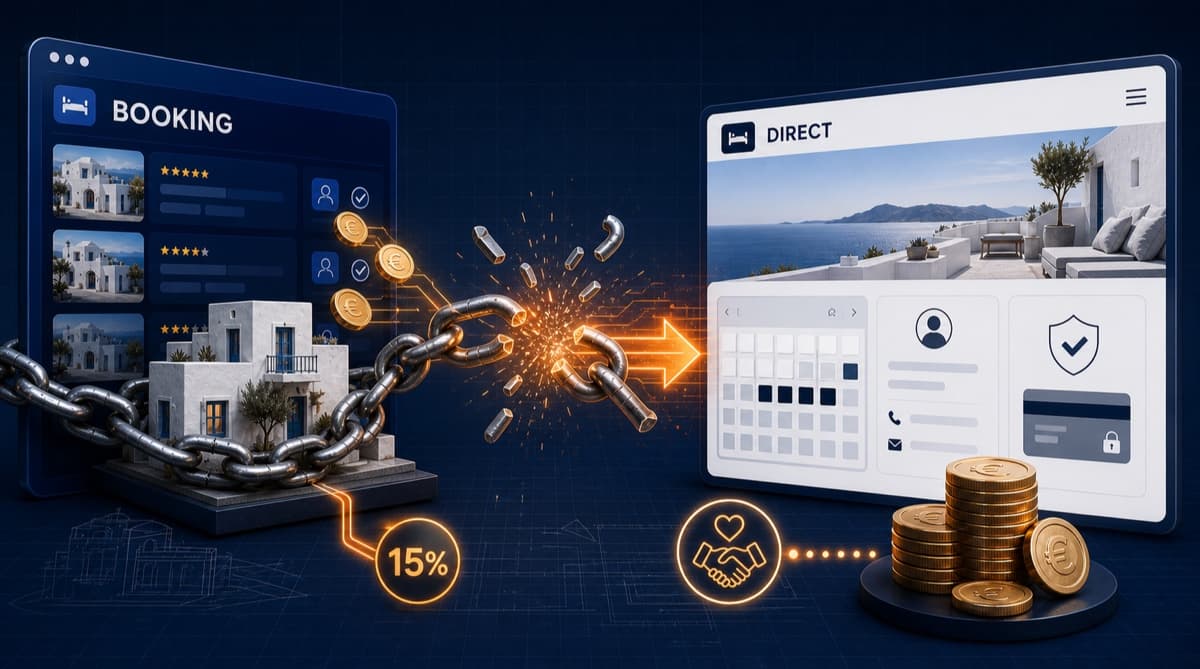
How to leave Booking.com: a 2026 guide for hosts
A step-by-step plan to reduce your dependence on Booking.com and win more direct bookings for your vacation rental.

What a bad website really costs your vacation rental
Estimate the possible cost of website friction using your own data, with clearly labelled scenarios, not guaranteed losses or returns.
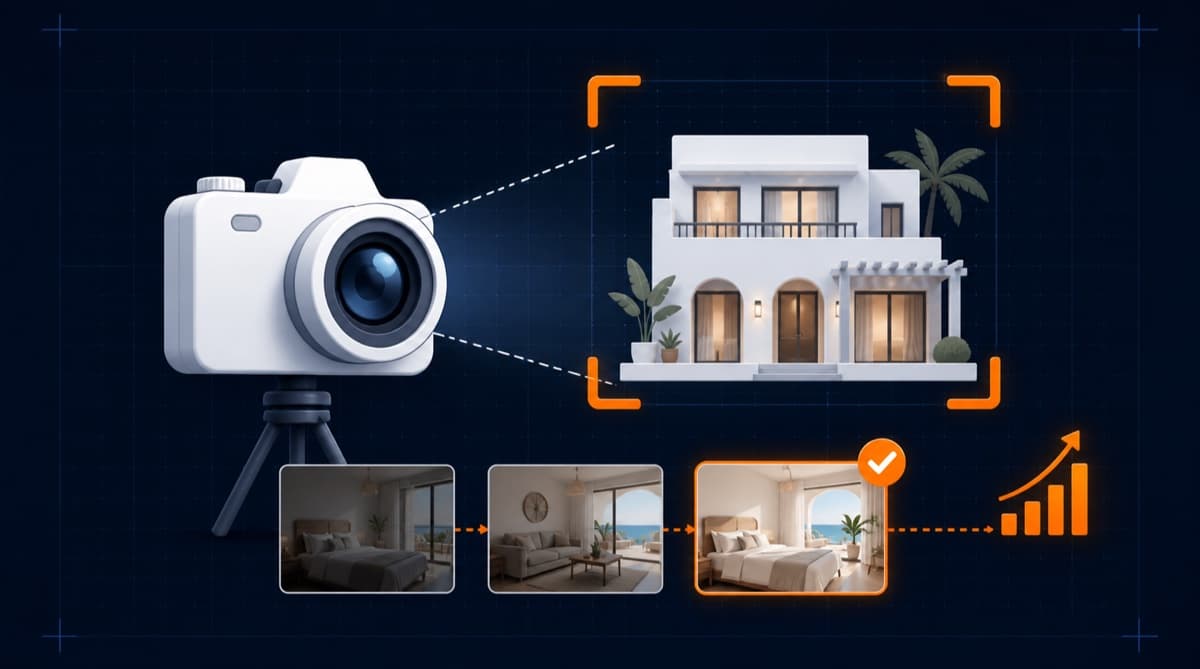
Vacation rental photography: the guide to more bookings in 2026
Photos are the #1 filter before anyone books. A practical guide to better shots, the right order, and more clicks on Booking.com and Airbnb.